Controversial Auckland intensification plans to be watered down.
Prime Minister Christopher Luxon is understood to have watered down controversial plans championed by Housing Minister Chris Bishop to intensify Auckland’s gentrified inner suburbs.
In a statement, Bishop confirmed “the Government is considering a range of options around housing capacity targets for Auckland and as Minister of Housing I will have more to say soon.”
It comes as Aucklanders have submitted in droves on the controversial government mandated Plan Change 120 that would see zoning changes in the city to permit an additional two million homes - many of those in the previously-protected wealthy central suburbs.
One source close to the Government told The Post the backtrack was a Captain’s call by Luxon and reflected the pressure National’s Auckland MPs were feeling over the issue. Luxon was both “stamping his authority within the party” and demonstrating he had listened to Aucklanders.
Bishop is touted as the most likely successor to Luxon amid ongoing speculation about the National Party leadership.
But the intensification push has put him at odds with the powerful Auckland block in caucus.
National’s Auckland MPs have been “obviously getting punched in the guts every second day over the issue”, a source said.
“National have to do something because unless they hold Auckland, [the coalition government] is f....ed.”
Sharon Murdoch’s cartoon from last December on the Luxon-Bishop intensification debate. Sharon Murdoch / The Post
To date the Government has sold its “going for growth” policy as a necessary reset, giving councils the tools to enable more housing supply and make home ownership more affordable.
But a widely used Government figure of Auckland needing two million additional houses over coming decades has been a lightning rod for opposition. The figure was used in a notification letter sent by the council to every Auckland household, and meetings held by character housing lobbies.
“What [Bishop] doesn’t get is Auckland’s a much more complicated place than Wellington or frankly, an economics textbook,” a government source said.
“If you want to see more houses built, it’s not as simple as removing all the zoning and saying anyone can build anything anywhere they want. You’ve got to connect the infrastructure, you’ve got to have the buses, otherwise it’s a nightmare.”
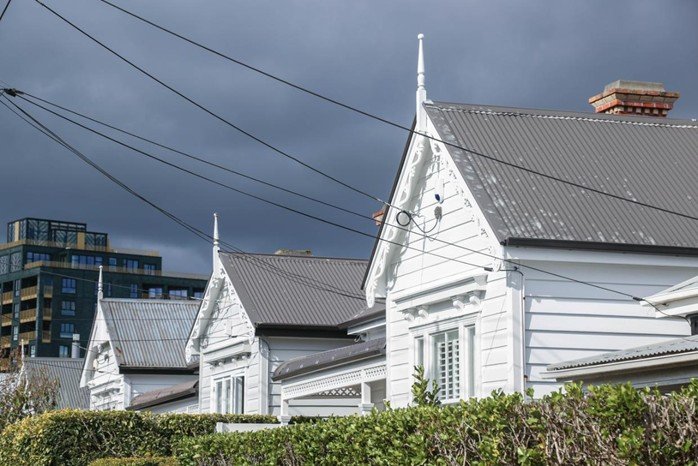
Character homes in central Auckland have long been a zoning battleground. Jonathan Killick
The legislation required the council to focus more development around train stations - most of which are sited within Auckland’s well-heeled central suburbs - making the proposition even harder to sell to the conservative voter base.
“You’ve got to increase housing supply, because otherwise young people will leave. But you’ve got to be able to say to the older crowd, we respect the lifetime of work and investment you’ve made to live in a nice suburb and it should largely stay that way,” says a political source. “But instead of doing it that way, they have created a kind of intergenerational civil war.”
Well-placed sources expect an announcement before Waitangi Day watering down that number of two million.
“They can say we needed more capacity than under the Auckland Unitary Plan, which was 900,000, but the target could brought back to 1.3m or 1.4m. I mean this is not science, it’s just political face-saving,” said one Auckland political source.
But it was unclear whether that would be by legislative repeal, or by way of a brief to the [Plan Change 120] independent hearings panel to look at the submissions.”
‘Politics as usual’
The Government has also been negotiating with Auckland Mayor Wayne Brown on a city deal, and while it has been shrouded in non-disclosure agreements, intensification is understood to be a core issue.
“We’ve got a whole lot of squabbles going with the government at the moment, I got to tell you,” Brown told The Post. ”It won’t be a win, but it’ll be a draw. “
“I’ll get quite a lot of what I want done, and I might have to trade a couple of things. But, I don’t think we will end up having two million houses.”
Brown says any upcoming concession from the government will be “the first signs they’re working out they have to deal with the biggest city as a partner”.
“And, it’s going to be a lesson in how they’re going to have to learn to deal with me.”
Auckland Mayor Wayne Brown says Wellington will have to learn to listen.Jonathan Killick / The Post
Brown is actually a proponent of intensification in the central suburbs, but says the excessive target has “upset a whole lot of people over something that will never happen”.
“There's a belief afoot from stupid people in power that the council is holding up growth in housing because of the planning rules. There are already 9,500 approved resource consents in Auckland that no one's acting on.”
Albert-Eden councillor Christine Fletcher says the government “did not appreciate what they were taking on” with Plan Change 120.
“We made it very clear that the existing secondary schools in the Auckland area, whether we’re talking Mount Albert Grammar School, Epsom Girls Grammar [or] Auckland Grammar, are already at capacity.”
“And there has been no land banking. No willingness or preparedness for growing that sort of social infrastructure, let alone the work that Watercare and others must undertake.”
Albert-Eden councillor Christine Fletcher Jonathan Killick / The Post
Fletcher unsuccessfully sought a council resolution to ask the government for three months to more carefully consult and plan out zoning changes, and she hopes the Government will recognise a pause is needed.
“We mustn't launch from one sense of madness to another, I think there needs to be some quiet, careful period of consultation. I do credit some of the MPs who’ve been speaking with me with understanding that there needs to be some change.”
However, Waitākere councillor Shane Henderson, who viewed the zoning changes as progress, says he’s disappointed that Auckland is being caught up in “the ping-pong of central government politics”.
“I don’t want to see politics as usual win out, which has happened so often through the history of the city. For us to walk back and actually cut back our expectations, I think that does show limited vision for the city.”
Henderson believes it’s wealthy central Aucklanders blocking progress and protecting their property values yet again.
“I’ve just come through an election in West Auckland where my constituents were saying we’ve taken intensification, while some other parts of the city feel like they don’t have to ... There’s a huge risk of alienating [western] suburban voters in exchange for city centre voters.”
ACT leader David Seymour, who returned to New Zealand this week to be greeted with the rumours of an upcoming announcement, said nothing had been formally communicated to him.
It’s been an issue that the Epsom MP has been hot on, having held his own public meetings to bring attention to the public submission process.
“All I would say is we need to find a balance between respecting the hard work of current property owners, while leaving open opportunities to future property owners. It’s difficult to believe we can’t find a better balance than what we have right now,” Seymour told The Post.
Comments are moderated during working hours and may not appear immediately.
Jonathan Killick is a senior reporter based in Auckland, investigating local politics and community issues.
The radical policy has been a bone of contention with National’s Auckland MPs, sparking fiery public meetings and opposition from some of the party’s staunchest supporters.
Auckland councillor - and former National MP Maurice Williamson - described it as a choice between “a lethal injection and a firing squad”.
In the background, sources say, have been secret negotiations involving Auckland mayor Wayne Brown and dissatisfied local MPs and coalition partners.

U-turn season starts with housing intensification - Matthew Hooton
Photo / Mark Mitchell
It wouldn’t be election year without at least some Government U-turns.
Top of the list is dropping plans to force Auckland Council to change zoning rules to allow another two million homes to be built over the next 30 years. The U-turn, which could come as soon as Monday, is a win for Auckland Mayor Wayne Brown but also for National, since it denies Act, New Zealand First and Labour a potent issue on which to raid the blue vote.
Without the U-turn, Act could look forward to an election year spent defending its voters in Epsom and Tāmaki from National’s Wellington diktat allowing apartment blocks to be built on either side of their homes, without even the infrastructure investment to support them.

More zoned land won’t solve housing woes.Do we even want more people in Auckland? Being bigger is different from creating a better city.
Comment: The Government is forcing Auckland Council to zone land for another two million dwellings. This is a target that neither planners nor politicians can justify and yet we’re ignoring the real drivers of unaffordability and the qualities that make our city worth living in.
Let’s be clear – the two million dwelling figure comes from Resource Management Act Reform Minister Chris Bishop. He has forced Auckland Council to produce a plan that enables this number of houses. The Council and its planners have acknowledged this. They say quite frankly that the draft plan is not the one they would have written for Auckland.
This result of this top-down target of two million more homes will be to allow intensification in most of Auckland’s suburbs and character areas. This will have a major impact on those living there, and in many areas will destroy their amenity, without improving either housing availability or affordability.
Bishop’s plan for Auckland is based on a myth that zoning more land for intensification automatically lowers prices.
The Auckland Unitary Plan added 900,000 zoned properties in 2016 (enough for over 30 years at current build rates). Yet median prices in Auckland increased by 40% between 2016 and 2021. They went from $820,000 to $1.148 million, a $328,000 jump in five years.
This clearly shows that flooding the market with zoned land when there is already an oversupply will not improve housing availability or affordability.
Targeting two million extra homes will drive bulldozers through our suburbs without tackling the real causes of unaffordable housing – wages, land-banking, material costs, and not enough help for first-home buyers. They also expose a policy paradox: central government insists on unrealistic capacity targets, while the real bottlenecks lie elsewhere.
It’s time to shift the dial from “how many houses do we zone for” to “how do people afford them?” If we are going to makes homes affordable, we need to face up to the real causes of our housing unaffordability.
This unaffordability stems from: low wage growth that can’t keep pace with housing costs; land-banking by developers and speculators keeping zoned land lying idle; high building material costs; a failure to keep building Kāinga Ora homes; and the lack of targeted financial support for first-home buyers.
We need to fix these problems, not zone for millions of extra dwellings. Our problems are economic, not planning, ones.
Rather than focussing on the planning system, and zoning endlessly, we should aim for policies that will actually move the needle: let’s increase real incomes by reversing public-sector cuts and improving wages, tax or rate undeveloped zoned land to discourage land-banking, bring down material costs, re-instate Kāinga Ora’s build programme on existing vacant sites, and redirect a greater share of the $2.104 billion accommodation supplement into low-interest, long-term home-buyer loans.
These measures target the affordability lifelines—such as income support and lower borrowing costs—rather than just the land pipeline.
Chris Bishop claims that zoning more land and creating more intensification will drive prices down. But look at Sydney, Melbourne and London: intensification without wage growth or public housing delivers the same sky-high rents and mortgages. More homes can mean lower costs—but that’s true only when new supply matches the market’s real constraints, not when land lies idle while fundamentals stay broken.
Auckland’s housing crisis won’t be solved by arbitrary dwelling targets or relentless densification of every suburb. The new plan will mean even historic Devonport will be forced to drop 257 properties out of its Special Character Area.
In Mt Eden and Kingsland, small pockets of character housing that have been carefully preserved and improved by their owners over many years will be needlessly destroyed by the intrusion of multi-storey apartment blocks, while development sites that have lain idle for years remain vacant.

Supercity intensification plan gets a temporary reprieve. Jonathan Killick, The Post, September 16, 2025
Image Sally Hughes
Auckland’s councillors have been given something of a concession by RMA Reform Minister Chris Bishop over sweeping new plans for intensification.
It follows a legislated requirement for Auckland Council to come up with a zoning plan for 2 million additional homes in the supercity by October 10 - an issue which has prompted tense debates amid the local election about where and how to add to the city’s housing stock over the next 30 years.
While the council is still required to notify the public of its proposed plan change by deadline, Bishop gave his assurances on Tuesday that the council would be given the time to allow the public to have its say.
In a letter to Mayor Wayne Brown and councillor Richard Hills, Bishop said he was looking at setting an 18-month timeframe for the process.
….
For some the concession has not gone far enough - Sally Hughes of the Character Coalition said the question remained: “Why do we need that level of intensification all at once?”. “We don’t need the potential for 2 million properties all at once.”
Hughes argued for “staged intensification”.
“There’s a whole derelict shopping centre down the bottom end of Dominion Road [in Mt Roskill] … that could be great apartment buildings with commercial properties underneath.
“If the community had felt that it had had a say about where the intensification went, there wouldn't have been all these angry meetings and all this upset.”
Hughes said the decision to appoint panels and hold hearings was a win for “people power”, with suburban residents having made it “patently obvious how unhappy they were” with Bishop.
“But it hasn’t won completely,” she added.
“In suburbs with a lot of villas and family homes there will still be the potential for that pepper potting and high rise buildings just plonked in the middle of a suburban street where people have lived for many years.”
“That is still possible with the amount of intensification that the Government is requiring all at once.”
Councillors will vote on notifying the proposed plan on September 24.